
Writing a marathon
To those about to NaNoWriMo, we salute you

This is one of my (very) occasional thoughts on the writing process. Stick around for next week if you’re awaiting my usual opportunities listings.
I’ve never been much of a tracker.
Once, in a stationery-buying binge, I got something called a habit tracker. Little more than a block of sticky notes, it had a grid with days of the week at the top and a list of blank spaces down the side. Here you could fill in the habits you wanted to set – say, going for a run, making your bed – and tick them off each day you did them.
Sticking to a habit for three weeks, so the logic went, would make it stick.

Looking it up now, I find that the science of this claim is very much disputed. It may take some people less time than that, and for others much longer. My own experience, of going to the gym for example, is that it is possible to form a habit only for it to be broken the minute the routine deviates. Going on holiday was a major culprit. Work drinks, Christmas parties and the like, another.
When it came to my little notepad, though, the problem was quite different. The hardest habit to form was that of actually using it.
I might do one of the little challenges I had set for myself, flossing my teeth or making my bed, but forget to record it for that day. Then I would miss out on the satisfaction of ticking it off. Then I would forget another day and suddenly have a backlog. Then I would find the whole thing to be a burden, and see my efforts at self-improvement as silly and pointless.
The tracking was a good way to get started. But it also became a drag. If I was being successful in my efforts, it was an annoying extra task to complete after expending my willpower on the main goal. If I was failing, it was a depressing reminder of that fact.
Log jam
I’ve been thinking about tracking when it comes to writing for a couple of reasons lately.
The first and most topical is that we are in the season of NaNoWriMo once again. And for all the repeated failures, questionable manuscripts, and numerous controversies that have come out of that initiative, I still think it’s a good one.
Logging your word count is a really good way to make you write something. Even if it’s 200 words. It’s better than clocking in with nothing at the end of the day. The fact that you can be very public with your NaNoWriMo counter adds a helpful dose of accountability. Or peer pressure1, however you want to see it.
The other reason is that this time last year, I became a sudden convert to Strava, the exercise tracking app.
When I first formed a regular running habit in spring last year, I was adamant that I would never use Strava. In fact I never took my phone with me at all, viewing it as an unnecessary encumbrance, both physically and mentally. Instead, to work out how far I was running, I did some elaborate Google Maps calculations of the local park, and counted my circuits2.
But when we moved, I found myself varying my routes for once, and curiosity got the better of me. I wanted to know how far I could run. Then I wanted to know if I could run further.
It was a remarkably useful health tool, one that did not add too much pressure thanks to the weekly progress chart – not everything had to be done in one session, and I could choose between several short jogs or just one or two longer ones and still keep on track – but which did motivate me to keep building on what I was doing.
I began to wonder if I could do the same to improve my writing routine – or lack thereof. Not least because I had recently interviewed Nat Eliason. A writer and coder, Nat made his own app for tracking writing progress, Prolific. I related to his reasoning behind the product, which was essentially to give yourself a dopamine hit from sharing the progress you’ve made, without sharing the writing itself when it’s still in rough draft stage. The social aspect means you can congratulate people on a writing session well done. Essentially, it’s Strava for writing.
Nat is, well, prolific. He recently wrote about his experience of writing a novel in just 26 days, which I really recommend if you are interested in hardcore drafting.

Inspired by all this, I had a go at tracking my writing habits. No sticky notes this time. No app, either (I eagerly await the Android version of Prolific, Nat). I opted for a spreadsheet.
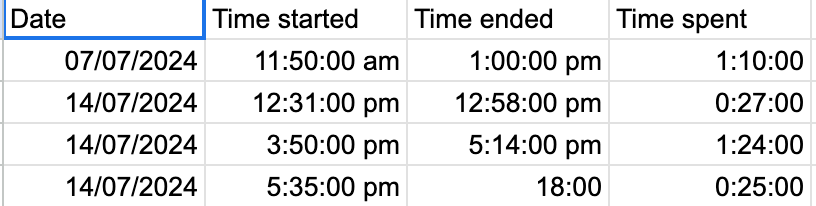
Because I mostly wanted to track editing progress on my novel, rather than drafting anything, I designed the sheet to track time instead of word count.
I had no particular goal in mind, and was simply curious. While I hadn’t timed my creative writing sessions before, I had done a similar experiment when I was a freelance journalist. Inspired by my husband, who has to track all the time he spends on each task for work, I set a timer on my phone each time I got down to a core task: research, writing, editing. The results? I was horrified by how little time I spent on the actual work, and how much more on emails, invoices, miscellaneous admin and various faffing.
Rough routine
Armed with that knowledge, this experiment began well. I found the timer a handy way to keep focus (I recommend using the stopwatch on your phone as a reminder not to get distracted by it) and I was satisfied to see the hours totting up in the column.
To add a bit more of that to-do list satisfaction, I added a second tab with some tasks I needed to do to my manuscript, and some rough dates by which I hoped to complete them. This also helped shape that formless feeling I sometimes get when I’m sitting down to think about this big text, and often get overwhelmed by the task before me.
In early August, a couple of things happened. The first is that my knee was injured3 and I was off running (and Strava) for the foreseeable. I still haven’t returned to jogging.
The second is I started to slip a couple of days here and there beyond my self-imposed deadlines. And I began to notice my timed sprints were getting shorter and farther apart. Once that happened, I began to forget to update the sheet, or to set my timer.
It was the habits notepad all over again.
I would love to blame the injury alone for why my writing routine slipped, and I do think that was part of it. Though it may be ridiculous that becoming housebound for a couple of weeks actually reduced my writing time, I think I was a little depressed about what had happened. I still am, to be honest. At the time, I was also in some pain and funnelled what energy I had into my job.
But the truth is the routine was already pretty sporadic. I haven’t had a solid writing schedule for a long time.
This makes me sad sometimes because I think of myself as a writer. But the way I engage with my craft is uneven, fairweather and increasingly fraught with stress.
Tracking helped in some ways and hindered in others. I watched a writing advice video once where the instructor advised thinking of your novel as an affair you’re having that you can sneak away to, escaping from your everyday life. I think I removed some of that romance, even though having some kind of plan is also necessary for the editing stage.
I was trying to think about whether my experiment was a success or not, and I came back again to Strava. Before my running habit finally clicked last year, I had spent years failing to build it. I had even set up an abandoned Strava account once before, a profile that now floats around doppelgänging and sometimes appearing in my suggested friends. I can’t work out how to access it or delete it.
Basically, the running routine didn’t click for me for a long time. Something needed to shift. When it finally did, I was careful about it, fearing the flame would extinguish if I fanned it too much. I didn’t push myself too hard, didn’t track what I was doing, almost like I had to look the other way and pretend I hadn’t noticed the progress I was making.
Only when I was much stronger, and had cultivated that inner feeling that tells you it’s time to go running without having to schedule it, did I begin to measure myself and go further. I think I may need to do that with writing.
No numbers November
When I wrote a few months ago that I hoped to put something in this newsletter about the relationship between writing and running, I had not anticipated that when I came to do so I would basically be doing neither.
Nevertheless, I hope despite my self-pitying tone this has been of interest. I would love to know more about your own writing routines and whether you track them in any way. If you are doing NaNoWriMo, best of luck to you – I’ve never done it in full but in previous years I’ve found it helpful to get some large chunks of drafts done.
As for my own routine, I think I will take things easy for now and do my own version of NaNoWriMo: no numbers November. No timing, no word counts. I need a bit of time away from the spreadsheet, and to allow myself to remember what it’s like to feel that urge, telling you it’s time to write. Then I’ll go for a walk, and log it on Strava.
Peer pressure, in my view, does not necessarily require anyone to think badly of you. It doesn’t require anyone to think of you at all. You only need to imagine that they might have an opinion on you and the myriad ways you are failing. I think writers are generally very good at having this instinct.
The number of circuits was always only one.
I use this odd, passive phrasing because the injury was very much not my fault but the fault of someone else, and I object to saying that I injured my knee, or that it was an accident. I doubt I’ll ever write more about it than that on here, though who knows. 20+ literary magazines seeking dodgy knee poems, anyone?